Technical content strategy
Content Marketing for Developer Tools: A Field Guide
Zadhid Powell · 20 min read

On this page
- Why developers distrust marketing in the first place
- Why Technical SaaS Content Fails (It's Not Effort)
- What Makes Developer-Tool Content Different
- What Good Developer Content Looks Like
- The Content Formats That Earn Developer Trust
- Who Should Write Your Developer Content
- Where AI Fits, and Where It Must Not
- The Workflow That Keeps Technical Content Accurate
- How to Distribute Developer Content Without Getting Flamed
- Meet the Developer at Each Stage
- How to Tell If Your Content Was Written by Someone Who Gets It
- Mistakes That Quietly Cost You Credibility
- How to Know Your Content Is Working
- Where This Connects to the Rest of Your Content
- Frequently asked questions
Most content marketing for developer tools fails for a reason nobody likes to say out loud: it was written for the buyer, but it gets judged by the engineer.
An engineer can spot a writer who has never shipped code in about two sentences. After that, nothing you publish gets the benefit of the doubt.
I write content for technical products for a living. I led the content team at ShortPixel, wrote for Kinsta and Whop, worked on Fluent Forms in its early days, and I write as a contract technical writer at HubSpot.
Across all of them the failure mode barely changes: the content reads fine to the marketing team and lands wrong with the exact people who decide whether the tool gets adopted.
This guide is the fix: why developers distrust marketing, what makes developer-tool content different, what good looks like, who should write it, where AI fits, and the workflow that keeps it accurate enough to earn a technical reader's trust.
Why developers distrust marketing in the first place
Before you write a word, understand the room you are walking into: developers have spent their careers being marketed to badly.
They have read the "10x your productivity" headline that linked to a thin tutorial. They have hit the "scalable, secure, enterprise-ready" landing page that could not tell them which database it used.
So they arrive skeptical, and that skepticism is earned.
Writing for developers is like cooking for chefs. They are not tasting the dish, they are tasting the technique.
They notice the shortcut you took, the step you skipped, the claim you could not back.
A diner says "this is good." A chef says "you used the bottled stock."
That changes the job. You are not trying to impress a developer with polish. You are trying to prove, fast, that you know what you are talking about.
Every concrete detail is a deposit in an account you are badly overdrawn on before you start. Every vague claim is a withdrawal you cannot afford.
The good news is that the bar, while high, is clear. Developers reward exactly the things most marketing avoids: specifics, trade-offs, honesty about limits, and working code.
Meet that bar and the same skepticism that worked against you flips.
A developer who decides you are credible becomes the most valuable reader you have, because they tell other developers.
Why Technical SaaS Content Fails (It's Not Effort)
When a developer-tool company gets burned by content, the usual diagnosis is "the writer didn't try hard enough." That is almost never it. The real problem is altitude.
Most content is written at the altitude of the buyer: outcomes, benefits, business value. Developers buy at a different altitude entirely: how the thing works, where it breaks, what it costs them in complexity.
A generic article does not just underperform. It costs you credibility with the one audience you cannot afford to lose.
There is a sharper version of this problem too: even a talented writer can ship content that is not vague but factually wrong, if nobody who understands the product checks it before it goes live.
That specific failure, and the review-gate fix for it, is deep enough to earn its own piece.
Pro tip: If your content explains that your API is fast but never why or how fast, you are writing marketing copy and calling it technical content. Developers know the difference.
What Makes Developer-Tool Content Different
Three things separate content for developers from ordinary B2B SaaS content, and none of them are about how well you write.
The reader can check your work. When you write for a marketer, they take your claims on trust.
When you write for a developer, they open a terminal. The terminal is a lie detector.
If your code sample does not run, the post is dead, and so is some of your authority.
Accuracy is not a nice-to-have here. It is the entire product.
The proof is the content. A developer evaluates your tool through your tutorials, your docs, and your comparison pages, often before they ever start a trial.
By the time they talk to sales, the decision is mostly made. Your content is the top of the funnel, and usually the middle and bottom too.
Distribution lives where developers already are. They are on Hacker News, Reddit, Dev.to, and in each other's GitHub issues, not refreshing your blog.
A post that only lives on your own site reaches almost none of them. That is its own discipline, and it is covered later in this guide.
What Good Developer Content Looks Like
Good technical content shares a few traits. None of them are about word count.
- It gets concrete fast. Real numbers, real commands, real output. "p95 latency dropped from 240ms to 90ms once the cache was on" beats "our tool is fast" every time.
- It shows the trade-off. Every technical decision costs something. Content that only lists upsides reads like a brochure. Content that says use this when X, avoid it when Y reads like a peer.
- It respects what the reader already knows. Do not define REST for a backend engineer. Match the buyer's altitude; do not talk down to it.
- It is honest about competitors. A fair comparison that admits where a rival wins earns more trust than a rigged one, and developers pay it back with attention.
The altitude fix, in one rewrite
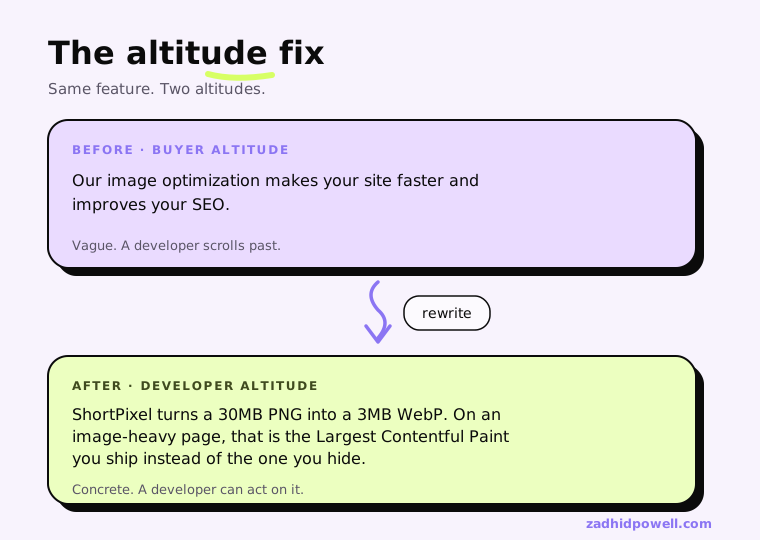
The gap between buyer-altitude and developer-altitude content is easier to see than to explain. Here is the same claim written both ways.
Buyer altitude: "Our image optimization makes your site faster and improves your SEO."
Developer altitude: "ShortPixel converts that 30MB PNG to a 3MB WebP. On an image-heavy page, that is the difference between a Largest Contentful Paint you are embarrassed by and one you ship."
Same product, same feature. The second one a developer can act on. The first one they scroll past.
Respect the reader's time
Every sentence a developer has to reread, every paragraph of throat-clearing before the answer, every "in this article we will explore" is friction you are charging them for.
Google's own search quality rater guidelines reward exactly the opposite: real expertise, stated plainly, nothing buried behind a slow warm-up.
Write the way you would explain it to a colleague at the next desk. Not stiffer, not more formal. Just clearer.
The fastest edit you can make to most technical drafts is to delete the first two paragraphs. The article almost always starts at paragraph three, where you stopped warming up and said the thing.
Pro tip: Put the answer first, then explain it. A developer who finds the answer in the first screen will stay to read your reasoning. One who has to dig for it will leave and never know your reasoning was good.
The Content Formats That Earn Developer Trust
Developers do not all want the same thing, and the format has to match the job. A few formats do the heavy lifting for developer-tool companies.
- Tutorials. The workhorse. A developer with a problem searches for how to solve it, and a tutorial that solves it with your tool inside is the most natural product demo there is. The only bar is that it runs start to finish.
- Documentation as marketing. Most teams treat docs as a cost center. For a developer tool, the docs are often the first thing a prospect reads and the thing they judge you on. Stripe's docs are the obvious example: developers name them as a reason they chose it, before they ever weigh the price. Twilio built a following the same way, on docs and tutorials rather than ads. Good docs are the firm handshake, first contact, and they tell the developer everything about how seriously you take them.
- Comparison and alternative pages. "X vs Y" and "alternatives to X" catch developers at the moment they are actively choosing. Done honestly, they rank and they convert. Done as a hit piece, they backfire.
- Benchmarks and teardowns. Real numbers a developer can verify earn links and citations like almost nothing else. They are expensive to produce and worth it.
- Build-in-public and changelogs. Shipping in the open builds trust over time. A good changelog is content. So is an honest postmortem.
The format is not the strategy. The job the reader is trying to do is the strategy, and the format follows from it.
When to use which: lead with tutorials and docs when you are early and need adoption. Add comparison pages once developers are choosing between you and a named competitor. Save benchmarks for when you have a real, defensible result.
Who Should Write Your Developer Content
This is where most developer-tool companies quietly lose: they hand technical content to a generalist because it is cheaper.
The generalist writes something that reads fine and means nothing, and the brand pays for it with a technical audience that stops trusting them.
A generalist writing about a tool they cannot use is a tour guide describing a country they have only read about. The sentences are grammatical. The facts are secondhand.
And anyone who has been there can tell in a paragraph.
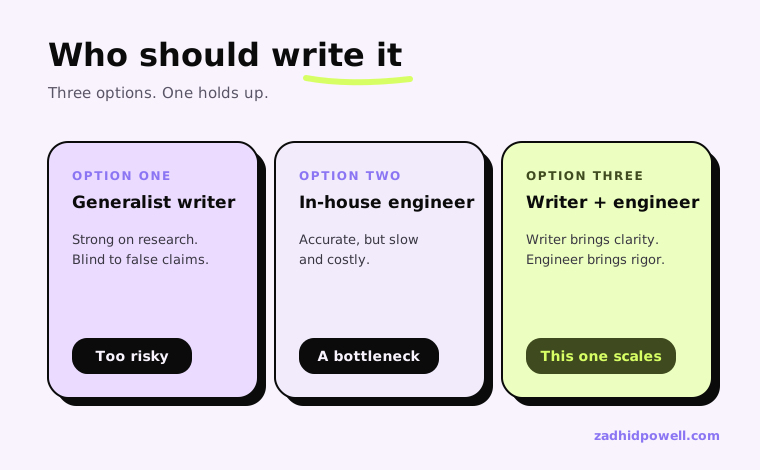
There are three options, and only one holds up at scale.
- A generalist writer. Cheap, fast, and wrong for this. They can research a topic, but they cannot tell when a claim is subtly false. With developers, subtly false is the same as false.
- An in-house engineer. Accurate, but expensive, slow, and usually reluctant. Most engineers do not want to write, and the ones who do have a backlog. Their time is your product.
- A technical writer who can read the code, paired with an engineer who checks it. The writer carries the structure, the clarity, and the search strategy. The engineer carries the accuracy. Neither has to do the other's job.
What to look for when you hire
The skill you are buying is not "can write." It is "can write this." When you are evaluating a writer for developer content, look for a few specific signals:
- They ask to see the product, not just the brief. The ones who want a login are the ones who will get it right.
- They ask sharp questions an engineer respects, and they know when an answer is hand-wavy.
- Their samples contain real commands, real numbers, and real trade-offs, not adjectives.
- They can name where a tool they wrote about falls short. A writer who only ever writes upside has never really understood a product.
Pro tip: You do not need a writer who can build your product. You need a writer who can read it, ask an engineer the right question, and recognize a non-answer. That is rarer than it sounds, and it is the skill worth paying for.
Vetting reduces how much a reviewer has to catch later, but it never replaces the review itself. If you want the real mechanics of that gate, I've written a full piece on where it goes missing and how to fix it.
Where AI Fits, and Where It Must Not
You cannot talk about content in 2026 without talking about AI, so let me be direct about how I use it.
AI is the reason a small team can produce real volume now. It is also the fastest way to flood your blog with confident, plausible, subtly wrong technical content if you let it run unsupervised.
The rule I hold to: treat AI like a fast intern, not a senior editor. An intern is genuinely useful. They draft, they research, they handle the first 70 percent.
They do not sign off, and they do not get the final word on anything a reader will check. AI drafts. The human technical review decides.
Here is the part that protects you. AI is most dangerous exactly where developers are most demanding: specific version numbers, edge-case behavior, security claims, anything that changed in the last release.
It will state all of them with total confidence and no idea whether they are true. So the accuracy gate is not optional when AI is in the loop.
It is the only thing standing between you and a confident lie with your logo on it.
Used inside those rails, AI is a real advantage. It lets one strategist plus one technical reviewer do the work of a small content team.
Used without them, it is a credibility leak that scales as fast as you publish.
Pro tip: Constrain the AI with the same one-page brief you would give a human. A vague prompt produces generic content at machine speed. A tight brief produces a usable first draft. The brief is the steering wheel.
The Workflow That Keeps Technical Content Accurate
The thing that separates content a developer trusts from content they roll their eyes at is a real accuracy gate, not a proofread.
A technical review by someone who could break the post. Here is the workflow I run:
- Brief first, in a doc or Asana. One page before a single sentence of the article: the angle, the query it targets, who it is for, and the one product outcome it ties to. No brief, no draft.
- Outline before draft. I turn the brief into an outline and lock it before writing. It is far cheaper to fix the structure here than after 2,000 words exist.
- Draft in the same doc. The brief and the outline keep the draft on-strategy instead of drifting generic.
- Review with the client, usually the CTO or CEO. This is the accuracy gate. The person who knows the product reads it and catches anything technically off before it goes live. Most content teams skip this step. It is the one that protects your credibility.
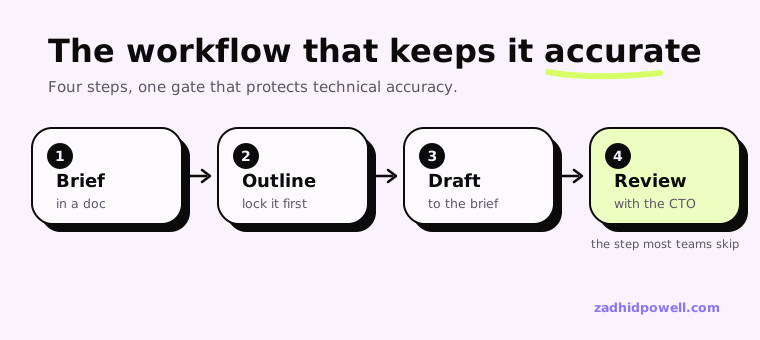
Step four, the technical review, is the step most teams skip under deadline pressure.
I cover exactly how that review gate should work, and why it catches what pure writing talent cannot, in a dedicated breakdown of the review-gate failure point.
If your team runs documentation and blog content through separate, uncoordinated processes, the same brief-and-review discipline applies to both: see how that split usually goes wrong.
Pro tip: If the only person reviewing your developer content is a marketer, you do not have an accuracy gate. You have a spell-check. The reviewer has to be technical enough to break the post.
How to Distribute Developer Content Without Getting Flamed
Publishing is not distribution. A great post that nobody links to or shares just sits there.
The catch is that the places developers gather are the same places that punish marketing the hardest. Here is what works.
- Show up as a person, not a brand. On Hacker News, Reddit, and Lobsters, a useful comment from a real engineer travels. A link drop from a faceless account gets removed.
- Lead with the value, not the link. Answer the question in the thread. If your content goes deeper, add the link as a footnote to an answer you already gave, not as the answer itself.
- Go where the specific developers are. Not "Reddit," but the one subreddit where your users hang out. Not "newsletters," but the two or three a backend engineer in your niche opens.
- Earn the right to post. Communities can tell the difference between a regular who occasionally shares their work and a drive-by promoter. Be the regular.
Here is what that looks like in practice. I once posted in a subreddit where AI agent developers gather.
It pulled more than 70 comments and over 30 direct messages, more real conversation than a month of publishing to a blog nobody had found yet.
It worked for one reason: it gave more than it asked. I answered a real question the people in that sub were stuck on, and the link was almost beside the point.
When not to bother: if your only plan for a post is to drop it in five communities the day it ships, skip it. You will spend credibility you cannot easily earn back.
Meet the Developer at Each Stage
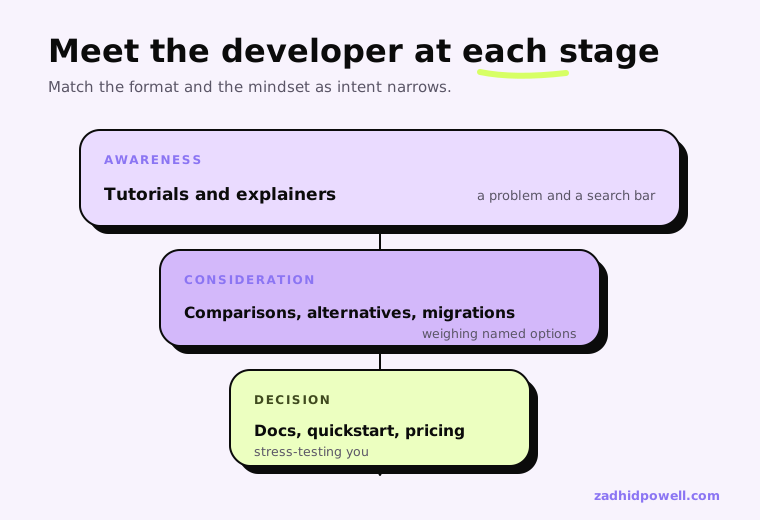
Not every piece of content has the same job. A developer who just discovered they have a problem needs something different from one comparing two tools with a credit card half out.
Map your content to where they are.
Awareness. They have a problem and a search bar. This is tutorial and explainer territory: how to do X, why Y happens, the conceptual piece that makes a hard thing click.
Julia Evans's zines are the standard to aim at here. They take a gnarly systems topic and make it land in a few pages.
Your tool appears because it is a natural way to solve the problem, not because the post is about your tool.
Consideration. They know the category and are weighing options. This is where comparison pages, alternative pages, integration guides, and migration guides do the work.
Honest, specific, and unafraid to say where a competitor is genuinely a better fit.
Decision. They are close, and now they are stress-testing you. This is your quickstart, your first call in five minutes, your docs, your security and pricing clarity.
At this stage the quality of your documentation is your sales pitch, and a confusing getting-started page loses deals that the marketing site already won.
One rule ties the stages together: never write a decision-stage hard sell into an awareness-stage tutorial. A developer who came to learn something and got a pitch instead remembers the bait, not the product.
This gets hardest on one specific type of page: API content, which has to serve a developer and a business buyer in the same piece regardless of funnel stage. I cover the technique for writing that dual-audience content without losing either reader.
How to Tell If Your Content Was Written by Someone Who Gets It
A quick test. Read any technical post on your site and ask:
- Does it get specific in the first 200 words, or warm up for three paragraphs?
- Could a developer act on it without leaving the page to fill in what you left out?
- Does it name the trade-off, or only the benefit?
- Would an engineer on your own team sign their name under it?
If the answer to any of those is no, the post was written for the buyer and not the engineer. That gap is exactly where adoption leaks.
If your content passes that test on substance but still feels slightly off in the room, the problem is probably tone, not fact. Here's the specific taxonomy of tics that make accurate content still read like marketing.
Mistakes That Quietly Cost You Credibility
Some mistakes lose a developer's trust in a single read, and none of them are exotic.
The most common:
- Code that does not run. The fastest way to lose an engineer. Test every sample.
- Claims with no number. Fast, scalable, secure mean nothing without a figure behind them.
- Defining things your reader already knows. Explaining REST to a backend engineer signals you do not know who you are talking to.
- Hiding the limitations. Every tool has them. Pretending yours does not insults a reader who will find them in ten minutes anyway.
- A demo disguised as a tutorial. If the steps only work inside your product with everything pre-configured, it is an ad, and it reads like one.
Those five are factual and structural failures, the kind a technical review gate exists to catch.
There's a separate register-level failure a technical review will not catch, because the facts are correct and the tone is just wrong: jargon used as a status prop, condescension, hedge-heavy phrasing.
I break down those tone-level tics separately, since they need a different fix than a fact-check.
How to Know Your Content Is Working
Credibility is the goal, but you still need signals you can point at. For developer content, track a few specific ones:
- High-intent rankings and the trials they drive. A tutorial or comparison page that ranks for a real problem, and the signups that follow it, is the cleanest signal you have.
- Docs and quickstart completion. If developers reach your getting-started page and finish it, your content is doing its job at the decision stage.
- Links and AI citations. Benchmarks and honest comparisons earn links and get quoted by AI answer engines. Watch for both.
- What developers say. The "finally, someone who gets it" comment in a thread is a leading indicator that the rest will follow.
Most of these compound over months, not weeks. Instrument them early so you can see the curve bend when it starts.
Where This Connects to the Rest of Your Content
Technical content does not work in isolation. The same accuracy and structure that earn a developer's trust also decide whether your content gets found at all, by Google and increasingly by AI answer engines.
The care that makes a tutorial accurate is the same care that makes it the kind of source those systems quote. Technical content, technical SEO, and AI-search visibility are one effort, not three.
You do not win developer trust by publishing the most. You win it when a skeptical engineer reads your content and thinks: finally, someone who gets it.
That reaction is worth more than any amount of traffic. Earn it once, and the developer does your marketing for you.
Keep going: the rest of this series
- The technical review gate that catches what talent alone cannot: why accurate content still ships wrong, and the process fix.
- How to write for developers without sounding like marketing: the tone-level tics that give away a writer who doesn't understand the product.
- Documentation vs content marketing: why two uncoordinated content sources compete instead of compounding, and the fix.
- How to write about your API for both developers and buyers: the two-track paragraph technique for dual-audience content.
Frequently asked questions
What is content marketing for developer tools?
It is attracting and converting a technical audience, developers and technical decision-makers, through content that proves your tool works: tutorials, documentation, honest comparisons, and code examples.
Unlike general B2B content, it is judged on technical accuracy, because the reader can verify your claims directly.
Why does most technical SaaS content fail?
It is usually written at the buyer's altitude (benefits and outcomes) when developers evaluate at a different altitude (how it works, where it breaks, what it costs in complexity).
A single inaccurate or hand-wavy claim costs credibility with the exact audience that decides on adoption.
Can AI write developer-tool content?
AI can draft it, but it cannot be the accuracy gate. Technical content needs a reviewer who can run the code and verify every claim, usually the client's own CTO or CEO.
The workable model is AI-assisted drafting against a tight brief, followed by a non-negotiable human technical review.
What types of content work best for developer tools?
Tutorials and documentation carry adoption, comparison and alternative pages convert developers who are actively choosing, and benchmarks earn links and citations. Match the format to the job the reader is trying to do.
How long does developer content marketing take to work?
Organic results typically take 6 to 12 months to compound, though specific, high-intent tutorials and comparison pages that target a real developer pain point can win sooner.
What is a technical review gate?
A technical review gate is a required checkpoint where someone who understands the product checks a draft's claims against reality before it publishes. The full breakdown is here.
Why does developer content sometimes sound like marketing even when the facts are right?
Usually because of tone-level tics: jargon used as a status prop, vagueness standing in for precision, or oversimplifying a genuinely complex mechanism. Here's the specific taxonomy and the fix for each one.
Should documentation and blog content be handled as one system?
They can stay owned by different teams, but they need to be checked against the same keyword map, or they end up competing for the same search query instead of compounding. Here's why that split causes real SEO and AI-citation problems.
How do you write API content that works for both developers and business buyers?
Use a two-track paragraph: state the business outcome in one sentence, then follow immediately with the specific technical mechanism that proves it. The full technique is covered here.
Written by
Zadhid Powell
SaaS content strategist and technical writer. I help software companies turn product knowledge into content that ranks, gets cited by AI, and supports pipeline.
Keep reading
Working on this kind of problem?
If this is relevant to what you are building, let's talk about it.
Get in touch