SaaS content marketing
Why Your SaaS Content Ranks but Doesn't Convert
Zadhid Powell · 5 min read

On this page
A page ranking on page one and a page driving revenue are two different outcomes. Most SaaS teams only track the first one.
This is the pattern I see across SaaS content audits more than almost any other, not a single documented before-and-after I can point to, but a failure mode consistent enough to name.
It shows up the same way nearly every time. Traffic climbs for months, the dashboard looks good in the board deck, and pipeline doesn't move.
The cause is rarely the writing quality. It's usually a mismatch between what a keyword is actually searching for and what stage of the buying decision the content is written for.
This piece is the diagnostic half of the SaaS content system: what to check before you assume the content itself is the problem.
Ranking Is Necessary. It Was Never Sufficient.
A keyword ranking well tells you Google trusts the page. It tells you nothing about whether the reader who found it was ever going to buy.
Google's own guidance on helpful content is explicit that it's optimizing for content that satisfies the searcher's actual need, not for content that satisfies a business's revenue goal. Those two things frequently point in different directions.
A page can satisfy a searcher completely and still never produce a customer, if the searcher was never a buyer to begin with.
The Buyer-Stage Mismatch
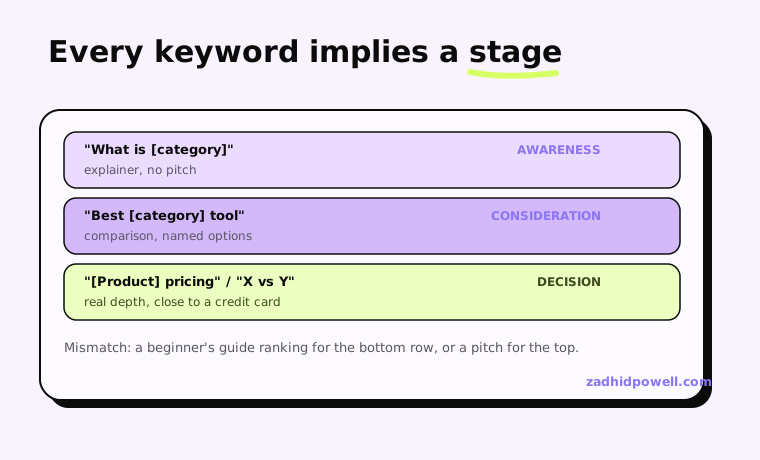
Every keyword carries an implied stage, whether the content written for it acknowledges that or not.
"What is [category]" is an awareness-stage query. "Best [category] tool" is consideration. "[Product] pricing" or "[Product] vs [Competitor]" is decision-stage, close to a credit card.
The mismatch happens when the content format doesn't match the query's real stage: a beginner's guide ranking for a decision-stage query, or a hard sell ranking for an awareness-stage one.
A reader searching an awareness query and landing on a hard sell feels ambushed, and leaves. A reader searching a decision query and landing on a beginner explainer feels like the page isn't taking their decision seriously, and also leaves.
Both pages can rank. Neither converts, because the format is answering a different question than the one the searcher actually asked.
This is the same underlying problem as the altitude mismatch that sinks developer-tool content, just measured against a buyer's stage instead of a reader's technical depth. I've written about that version of it separately.
The Signals That Your Content Ranks but Doesn't Convert
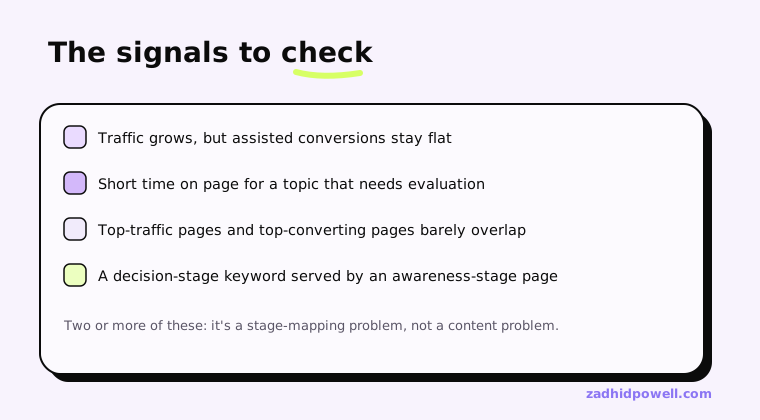
- Traffic is growing, but assisted conversions or trial signups attributed to organic content are flat or declining as a share of the total.
- Time on page is short for a topic that should take real engagement to evaluate, a sign the page answered a simpler question than the reader actually had.
- The highest-traffic pages and the highest-converting pages barely overlap when you pull both lists side by side.
- A high-intent keyword, pricing, comparison, or alternative, is being served by a piece written like an awareness-stage explainer.
Pro tip: Pull your top ten pages by traffic and your top ten by assisted conversion side by side. If the overlap is small, you don't have a content problem. You have a stage-mapping problem.
Fixing the Mismatch Without Losing the Ranking
The fix is rarely a rewrite from scratch. It's usually adding what the actual buyer stage needs without removing whatever earned the ranking.
If an awareness-stage page ranks well but never converts, the fix is a clear, low-pressure link to the decision-stage content it should hand off to, not turning the awareness page itself into a pitch.
If a decision-stage keyword is served by content too shallow for that stage, the fix is depth: real pricing detail, a real comparison, the objections a buyer at that stage actually has.
Gartner's research on the B2B buying journey found buyers complete roughly 80 percent of their purchase process alone, with no salesperson to correct a wrong-stage page. The content has to get the stage right, because nobody is there to fix it in the moment.
Search Engine Land's guide to fixing keyword cannibalization covers the mechanical side well: know exactly what each page is supposed to rank for and convert on, so two pages aren't accidentally trying to do the same job.
The goal isn't fewer pages that rank. It's every page ranking for the query it can actually convert.
Traffic that never converts is still worth having, if it's compounding toward pages that do. That's the asset-building half of this system.
The pages most likely to close the gap between ranking and revenue are comparisons and alternatives. Here's how to build those well.
None of this is visible without the right measurement in place. Here's what to actually track.
Frequently asked questions
Why does SaaS content rank well but not generate revenue?
Usually a buyer-stage mismatch: the content format doesn't match the actual intent behind the keyword it ranks for.
An awareness-stage explainer ranking for a decision-stage query satisfies the search engine's relevance check without satisfying a buyer who's close to deciding.
How do you know if your content has a stage-mismatch problem?
Compare your top ten pages by traffic against your top ten by assisted conversion. If the overlap is small, your highest-traffic pages and highest-converting pages are different pages, which usually means the format doesn't match the query's real stage.
What's the difference between an awareness-stage and decision-stage keyword?
Awareness-stage queries ask what something is or why a problem happens. Decision-stage queries name a product, a competitor, or pricing, and come from someone close to choosing.
Content built for one rarely converts on the other.
Should you rewrite a page that ranks well but doesn't convert?
Rarely from scratch. Usually the fix is adding what the actual buyer stage needs, like a clear handoff to decision-stage content or real pricing depth, without removing whatever earned the original ranking.
Written by
Zadhid Powell
SaaS content strategist and technical writer. I help software companies turn product knowledge into content that ranks, gets cited by AI, and supports pipeline.
Keep reading
Working on this kind of problem?
If this is relevant to what you are building, let's talk about it.
Get in touch